How to 23 April 2026
Measuring your walls
Ordering wallpaper is the one part of decorating where guessing gets expensive. Order too little and you risk a second batch that does not quite match; order far too much and unopened rolls gather dust. The good news: the maths takes five minutes and a tape measure.
Here is the method we use ourselves, with a worked example you can copy for your own room.
Start with the perimeter
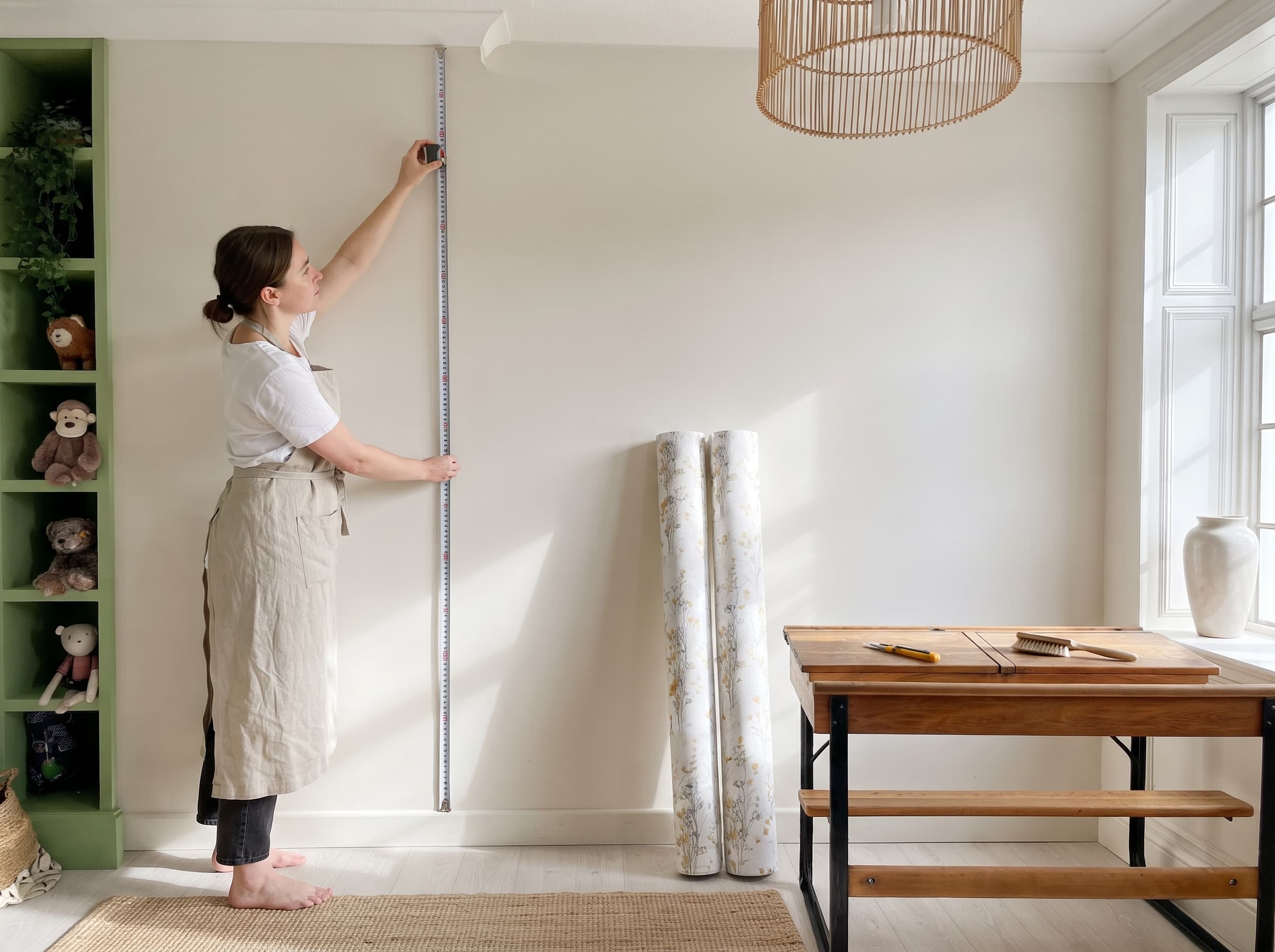
Measure the width of every wall you plan to paper and add them together — that is your perimeter. Then measure the height from skirting to ceiling at the tallest point of the room. Old houses are rarely level, so a couple of readings in different spots is worth the extra minute.
For now, ignore standard doors and windows. The offcuts they create are usually swallowed by trimming waste, and keeping them in the sum builds in a sensible safety margin.
The roll maths
A standard European roll is 10.05 metres long and 53 centimetres wide. Three numbers get you to an answer. First, your drop: wall height plus ten centimetres for trimming top and bottom. Second, drops per roll: divide 10.05 by your drop and round down. Third, strips needed: divide your perimeter in metres by 0.53 and round up.
Divide strips needed by drops per roll, round up again, and that is your roll count.
A worked example
Take a room four metres by three, so a 14-metre perimeter, with 2.40-metre ceilings. The drop is 2.50 metres, and 10.05 divided by 2.50 gives four full drops per roll. The perimeter needs 14 divided by 0.53 — call it 27 strips. Twenty-seven strips at four drops per roll is 6.75, so you order seven rolls.
Pattern repeat changes the sum
Patterned designs need each strip cut so the motif lines up with its neighbour. Check the label for the repeat — say 32 or 64 centimetres — and add one full repeat to your drop length before dividing. An offset match (often written as a split figure such as 64/32) shifts alternate strips by half a repeat and wastes a little more, so large-repeat designs may cost you an extra roll.
Finally, make sure every roll carries the same batch number, and consider one spare roll from that batch. It is cheap insurance against a mis-cut today or a scuffed strip in five years.